
1. Confectionery Sugar Reduction Chemistry: The Science of Bulk & Sweetness Synergy
The global confectionery sector is undergoing a profound structural shift. Driven by sugar taxes, rising diabetes and obesity awareness, and the explosive growth of clean-label consumer preferences, formulators can no longer rely on traditional sucrose and glucose syrup matrices. However, in confectionery manufacturing—ranging from hard-boiled candies and pectin gummies to aerated chews and compound chocolates—sucrose does not merely contribute sweetness; it acts as a structural bulking agent, controls glass transition temperature ($T_g$), governs plastic viscosity, dictates boiling point elevation, and modulates moisture sorption isotherms.
When removing sucrose, simply substituting high-intensity sweeteners (HIS) leads to immediate physical and sensory failures. High-intensity sweeteners like Monk Fruit Extract (Mogroside V) and Stevia Extract (Rebaudioside M/D) supply potent zero-calorie sweetness (up to 250–350 times sweeter than sucrose) but offer zero solids volume. Conversely, polyols such as Erythritol, Maltitol, and Isomalt provide bulk but introduce distinct physical challenges—such as endothermic heat of solution (strong cooling sensation), high hygroscopicity, low glass transition temperatures leading to sticky or grainy candies, and gastrointestinal tolerance limits.
Information Gain: Physical Chemistry of Sugar Reduction in Candies
Successful sugar replacement in confectionery requires a dual-phase approach: Phase A (Hydrocolloid & Soluble Fiber Bulking Matrix) to establish structural viscosity, glass transition ($T_g > 35^\circ\text{C}$ for hard candy storage stability), and water activity ($a_w < 0.60$), paired with Phase B (Synergistic Natural High-Intensity Sweetener System) to align the temporal sweetness curve with natural sugar without lingering bitterness or metal notes.
At WISC Biotech Co.,Ltd., our application engineers have characterized the sensory synergy between triterpenoid glycosides (Mogroside V) and steviol glycosides (Reb M/Reb D). By combining these natural botanical molecules with non-digestible soluble fibers (such as soluble tapioca fiber or resistant dextrin), confectionery producers achieve complete 1:1 sucrose replacement, preserving chewiness, mouthfeel, micro-crystalline structure, and shelf life while keeping calorie counts near zero.
2. Recommended Product Matrix: Confectionery Low Sugar Sweeteners
To address varied processing temperatures, pH ranges, and shelf-life requirements across different confectionery lines, WISC Biotech Co.,Ltd. offers a targeted suite of natural sweetening ingredients and custom blend systems:
H2-Luo® Monk Fruit Extract (Mogroside V 25% – 60%)
Derived from non-GMO Siraitia grosvenorii via water extraction and ultrafiltration. Highly heat-stable up to 150°C, zero calorie, non-glycemic. Imparts a warm, rounded, clean sweetness without the liquorice or metallic aftertaste associated with legacy synthetic sweeteners.
H2-Via® Stevia Extract (Reb M 95% / Reb D)
Enzymatically produced or plant-extracted Rebaudioside M delivering a sweetness profile virtually indistinguishable from cane sugar. Eliminates lingering bitterness, making it ideal for sour gummy candies, hard mints, and functional chocolate coatings.
Confectionery Pre-Blended Sugar Reduction Systems
Custom co-processed or dry-blended systems combining Erythritol / Allulose + Mogroside V + Soluble Tapioca Fiber. Engineered specifically for 1:1 direct sugar substitution in high-speed depositing and panning systems.
Monk Fruit Concentrated Juice (De-colored & De-flavored)
A 100% natural, fruit juice concentrate providing 65–70° Brix sweetening power. Perfect for USDA Organic certified fruit snacks, gelatin-free pectin gummies, and natural chewable tablet applications.
3. Category-Specific Formulation Solutions & Technical Engineering
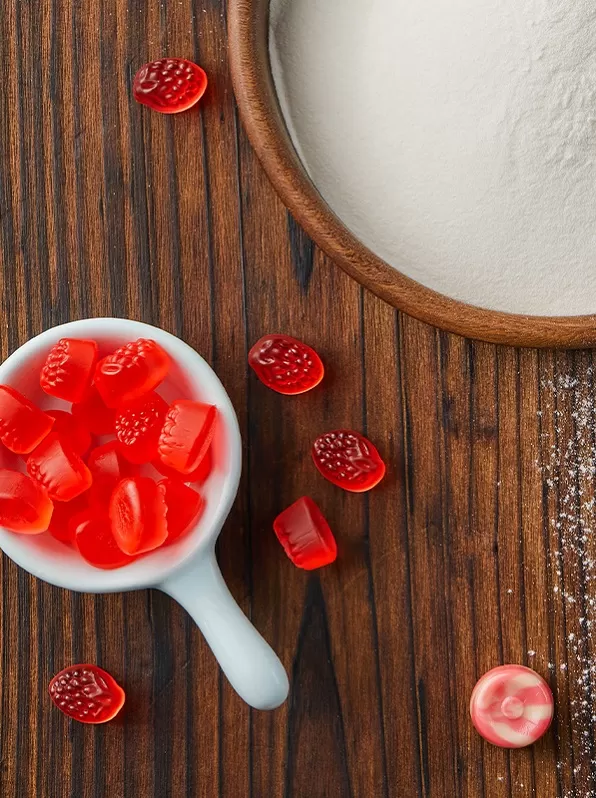
A. Gummy & Jelly Candies (Pectin, Gelatin & Starch Matrices)
Gummy confectionery represents the fastest-growing market segment, particularly in functional health supplements (vitamin gummies, collagen bites). Replacing corn syrup and sucrose in gummies presents two major technical hurdles: gel setting kinetics and hygroscopic moisture retention.
- Pectin Gummy Systems: Citrus pectin requires precise brix levels (typically 75–78° Brix) and acidic pH (3.2–3.5) for proper gelation. When replacing sugar with Erythritol/Fiber blends, solid precipitation or premature gelling can occur. WISC Biotech's H2-Luo® Monk Fruit Extract combined with Soluble Tapioca Fiber allows boiling to 76° Brix without polyol crystallization.
- Gelatin & Starch Gummies: Replacing bulk solids with allulose or soluble dextrin lowers the water activity ($a_w$), extending shelf life while preserving elasticity and bite clarity.
B. Hard-Boiled Candies & Lozenges
Hard candies are amorphous glass states. If the glass transition temperature ($T_g$) of the sweetener matrix drops below room storage conditions ($25^\circ\text{C}$), the candy absorbs ambient humidity, resulting in surface stickiness, cold flow, and graining.
Technical Formulation Solution: Utilizing Isomalt or Hydrogenated Starch Hydrolysates (HSH) as the primary glass-forming base, spiked with 0.03%–0.06% Mogroside V 50% from WISC Biotech Co.,Ltd. This yields an exceptional $T_g > 45^\circ\text{C}$, ensuring crystal-clear clarity, excellent heat resistance up to 145°C vacuum cooking, and long-term shelf stability without cold flow.
C. Sugar-Free Chocolates & Compound Coatings
In chocolate mass, water content must be strictly capped below 0.5% w/w to avoid severe viscosity spikes during conching and tempering. Standard polyols often retain bound moisture, disrupting cocoa butter crystallization and inducing fat or sugar bloom.
WISC Biotech Optimization: We offer micro-milled, low-moisture Reb M & Mogroside V Dry Complexes micronized to $D_{90} < 20\,\mu\text{m}$. This particle size matches cocoa solids, preventing grittiness while maintaining ideal Casson yield stress and plastic viscosity during high-speed enrobing and molding.
4. Technical Parameter & Physicochemical Comparison Table
The table below provides food scientists and procurement specialists with key analytical parameters comparing traditional sugars with WISC Biotech’s portfolio of natural confectionery sweeteners:
| Sweetener / Attribute | Sweetness (vs Sucrose=1) | Caloric Value (kcal/g) | Thermal Stability (°C) | Cooling Effect (kJ/kg) | Glycemic Index (GI) | Confectionery Suitability |
|---|---|---|---|---|---|---|
| Sucrose (Baseline) | 1.0 | 4.0 | 160°C (Caramelizes) | -18.0 (Neutral) | 65 | Traditional Standard |
| Mogroside V 50% (WISC) | 220 – 250x | 0.0 | > 150°C (Stable) | 0.0 (None) | 0 | Hard Candy, Gummies, Mints |
| Stevia Reb M 95% (WISC) | 250 – 300x | 0.0 | > 140°C (Stable) | 0.0 (None) | 0 | Chocolate, Sour Gummies |
| Erythritol (Bulk Partner) | 0.7 | 0.2 | > 160°C | -43.0 (Strong) | 0 | Chocolate, Mints (Needs HIS Blend) |
| Allulose (Bulk Partner) | 0.7 | 0.4 | 140°C (Browning) | -19.0 (Mild) | 1 | Chewy Candies, Caramel |
| Isomalt (Bulk Partner) | 0.5 | 2.0 | > 160°C | -39.4 (Moderate) | 2 | High-$T_g$ Hard Candies |
5. Global Confectionery Procurement & Market Trends (2025–2030)
Procurement directors operating in global food conglomerates face dynamic market pressures. Understanding emerging industry trends is critical to making resilient supply chain decisions:
Trend 1: Shift Away from Artificial Sweeteners (Sucralose, Aspartame, Acesulfame-K)
Consumer pushback against synthetic chemical additives has intensified following updated health guidance from international bodies (including WHO and EFSA). Tier-1 confectionery brands are systematically reformulating products to remove sucralose, acesulfame-K, and aspartame, replacing them with plant-derived alternatives like Monk Fruit Extract and Stevia Reb M.
Trend 2: Ultra-Clean Labeling & "No Added Polyol" Positioning
While polyols like Maltitol and Sorbitol have historically dominated sugar-free candies, mandatory warning labels regarding laxative effects ("excessive consumption may produce laxative effects") in the EU and North America restrict brand growth. Leading brands now leverage combinations of soluble tapioca fibers and WISC Biotech Mogroside V to eliminate synthetic polyol warnings while achieving 0g added sugar claims.
Trend 3: Functional & Nootropic Supplement Gummies
Confectionery formats are increasingly merging with dietary supplements. Formulating active ingredients (Melatonin, Ashwagandha, Vitamin C, Zinc, Nootropics) into gummies demands high thermal stability from the sweetener matrix. Monk Fruit Extract's non-reactive triterpenoid structure prevents degradation or cross-linking with active pharmaceutical or nutraceutical ingredients during thermal processing.
Trend 4: Farm-to-Factory Traceability & ESG Procurement Metrics
Global enterprise buyers now audit raw material suppliers on carbon footprint, agricultural sustainability, and supply assurance. WISC Biotech Co.,Ltd. maintains dedicated, sustainable monk fruit planting bases in Guangxi, China, ensuring complete vertical integration, transparent pesticide management, and direct economic support to local farming communities.
6. Company Profile & Manufacturing Advantages: WISC Biotech Co.,Ltd.
Founded in 2008, WISC Biotech Co.,Ltd. has evolved into a global leader in natural plant extract innovation and sugar reduction solutions. Recognized as a National High-Tech Enterprise and one of the Top 10 Plant Extract Suppliers in China, we operate as one of the Eight Initiators of the Chinese Plant Extract Industry Alliance.
203+ National Invention Patents
Continuous investment in extraction technology, membrane separation, and flavor modification research ensures industry-leading purity and taste profile mastery.
650+ MT Annual Mogroside V Capacity
State-of-the-art automated extraction facilities guarantee uninterrupted bulk supply, price stability, and rapid order fulfillment for multinational buyers.
Global Quality Certifications
Fully audited and certified under NSF-cGMP, BRC (Grade AA), ISO9001, ISO22000, HALAL, KOSHER, and Non-GMO Project Verification.
Exporting to 70+ Countries
Robust international logistics, specialized regulatory compliance support, and regional application tech support in North America, Europe, Asia, and Latin America.
7. Frequently Asked Questions (FAQ) for Confectionery Procurement & Formulators
Below are technical answers to common queries submitted by global procurement teams and R&D managers when evaluating Confectionery Low Sugar Sweeteners:
Accelerate Your Low-Sugar Confectionery Innovation
Partner with WISC Biotech Co.,Ltd. to access premium plant-based sweeteners, custom sugar reduction systems, and expert formulation support. Request samples, CoA documentation, or technical consultation today.